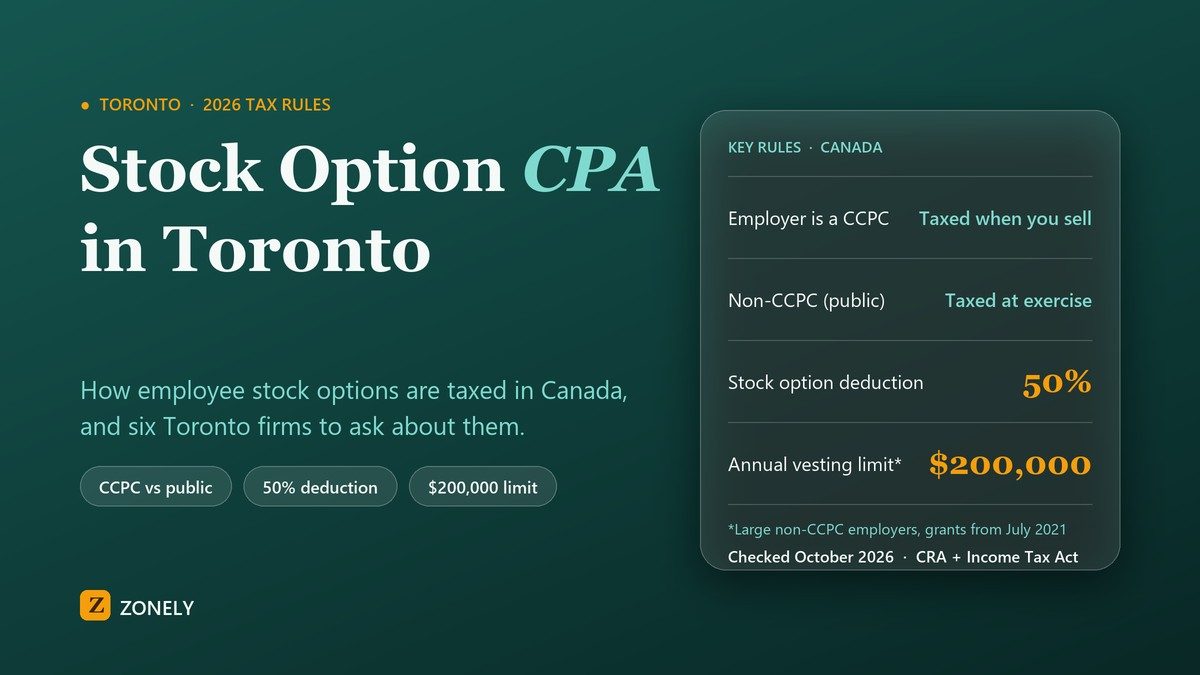
Stock Option CPA in Toronto: 2026 Tax Rules + 6 Firms
Short answer: if you hold options from a Canadian employer, the tax you owe depends mainly on two things: whether the employer is a Canadian-controlled private corporation (CCPC), and whether your options qualify for the 50% stock option deduction. A CPA matters most when you are about to exercise, when a company is being sold, or when your grant is large. This guide explains the rules, then lists six Toronto firms, each of which has published something on stock options, with contact details taken from the firm's own website.
Last verified: October 10, 2026, against the CRA's security options page (updated March 26, 2026) and the Income Tax Act. Tax rules can change with a federal budget, so check the CRA page for updates. This is general information, not tax advice.
How employee stock options are taxed in Canada
An employee stock option lets you buy shares of your employer at a fixed price (the exercise or strike price). Nothing is taxed when the option is granted. A taxable employment benefit arises when you acquire the shares for less than their fair market value, or when you sell or dispose of the options for a gain.
The CRA calculates the benefit as the fair market value of the shares when you acquire them, minus the amount you paid for the shares, minus anything you paid for the option itself.
CCPC versus non-CCPC: when the benefit is taxed
| Employer is a CCPC | Employer is a non-CCPC (for example, a public company) | |
|---|---|---|
| Benefit included in your income | In the year you dispose of the shares | In the year you acquire the shares |
| Employer payroll withholding on a non-cash exercise | No income tax, CPP or EI withholding | Income tax and CPP withheld; EI not withheld |
A CCPC is, broadly, a private corporation resident in Canada that is not controlled by non-residents or by public companies. For a CCPC grant, the exercise itself usually creates no tax bill; the tax arrives when you sell, so you must report the benefit yourself that year. For a non-CCPC grant, tax is due at exercise even if you keep the shares, so you may need cash to cover it.
A worked example
Assume a non-CCPC grants you 1,000 options with a $10 exercise price, equal to the share value on the grant date. You exercise when the shares are worth $25, then sell later at $30. Assume the 50% deduction applies and ignore withholding, alternative minimum tax and fees.
- Employment benefit at exercise: 1,000 × ($25 − $10) = $15,000.
- 50% deduction: $7,500, so $7,500 is added to your taxable income.
- Cost base of the shares: $25 per share, the fair market value on the exercise date.
- Capital gain on sale at $30: 1,000 × ($30 − $25) = $5,000, of which 50% ($2,500) is taxable.
If the employer were a CCPC, the same numbers apply, but the $7,500 net benefit and the $2,500 taxable capital gain would both fall in the year you sell the shares.
The 50% stock option deduction
Paragraph 110(1)(d) of the Income Tax Act lets you deduct one half of the benefit when all of these conditions are met:
- the security is a “prescribed share” (or a mutual fund trust unit);
- the amount you pay under the agreement is not less than the fair market value of the security when the agreement was made; and
- you were dealing at arm's length with the employer immediately after the agreement was made.
There is a second route for CCPC shares. Paragraph 110(1)(d.1) allows the same one-half deduction if you did not dispose of or exchange the shares within two years of acquiring them, and you did not claim the (d) deduction on the same benefit. In practice, this is why the exercise price matters so much: options granted “in the money” (below fair market value) fail the first test.
The $200,000 annual vesting limit
For options granted on or after July 1, 2021, a cap applies to some employers:
- Who it affects: options from a non-CCPC or mutual fund trust that has, or is part of a consolidated group with, revenues of more than $500 million.
- Who it does not affect: options from CCPCs and from non-CCPCs below that revenue threshold.
- How it works: only options whose underlying shares were worth up to $200,000 at the grant date, counted by the calendar year in which they vest, qualify for the 50% deduction. The rest are “non-qualified securities.”
- Example: if 100,000 options at $5 all vest in one year, $200,000 ÷ $5 means 40,000 qualify and 60,000 do not.
- Several agreements: the limit is shared across agreements with the same employer and with employers it does not deal with at arm's length. When agreements vest in the same year, the oldest agreement uses up the limit first.
- Employer choice: a covered employer can choose to designate options as non-qualified even where they would have fit under the limit.
- Notice: the employer must tell you in writing which options are non-qualified within 30 days after the agreement is made.
Options granted before July 1, 2021 are not subject to this cap.
Rules that did not change
The 2024 federal budget proposed reducing the stock option deduction to one-third for larger benefits. On March 21, 2025, the Government of Canada announced it would not proceed with that change, and the CRA's page confirms it. The 50% deduction and the $200,000 limit described above remain the rules.
What you will see on your tax slips
For non-CCPC shares, your T4 shows the benefit with code 38 and the deduction with code 39. Code 41 is used for the two-year CCPC deduction. The benefit is part of your employment income, and the deduction is claimed on line 24900 of your return. For CCPC shares, your employer generally reports nothing at exercise, so you report the benefit yourself in the year you sell.
An old rule you may still run into
Before March 4, 2010, employees of non-CCPCs could elect to defer part of the benefit until they sold the shares. That election was repealed for options exercised after 4:00 p.m. Eastern time that day. If you still carry a deferred balance, Form T1212 must be completed with your return each year until it is gone.
When it is worth hiring a CPA
- You are about to exercise a large number of non-CCPC options and need to plan the cash for the tax and the timing across tax years.
- Your employer is a private company that is being sold or going public.
- Your grant may exceed the $200,000 limit, or your options were granted in the money.
- You are moving into or out of Canada while holding options. Cross-border moves can trigger special rules, so get advice before you exercise or leave.
- The size of the benefit or gain may trigger alternative minimum tax, whose rules changed starting in 2024.
6 Toronto CPA firms to consider
Each firm below has a Toronto office and has published something on employee stock options. Zonely does not rank or endorse them, so they are listed alphabetically. Contact details and services come from each firm's own website as of October 10, 2026. Some of the articles are several years old and predate later changes, so treat them as a sign of experience, not as current tax guidance, and ask the firm directly (the checklist below can help).
1. BDO Canada LLP – Toronto (Bay Street)
- Address: 222 Bay Street, Suite 2200, Toronto, ON M5K 1H1
- Phone: 416-865-0200
- Website: bdo.ca/locations/bdo-toronto
- Stock option content: BDO's Canadian tax professionals wrote a July 2021 summary of Canada's new employee stock option rules in BDO's global employer services newsletter.
- Note: a large national firm with a national office at 20 Wellington Street East, Suite 500. Ask which office and team would handle your return.
2. Crowe Soberman LLP
- Address: 2300 Yonge Street, Suite 1300, Toronto, ON M4P 1E4
- Phone: 416-964-7633
- Website: crowe.com/ca/crowesoberman
- Services listed: advisory, tax, business management, cloud accounting, family office, valuations and forensics.
- Stock option content: a 2019 infographic series on employee stock options from its Tax Group, covering CCPC options. It predates the 2021 rules.
3. Fuller Landau LLP
- Address: 151 Bloor Street West, 12th floor, Toronto, ON M5S 1S4 (Toronto head office)
- Phone: 416-645-6500
- Website: fullerllp.com
- Stock option content: “New stock option rules: What you need to know” (October 19, 2022), covering the $200,000 vesting limit, qualifying and non-qualifying securities, and the employer deduction.
4. GTA Accounting – Toronto (Spadina Ave.)
- Address: Suite 504, 260 Spadina Ave., Toronto, ON M5T 2E4
- Phone: (416) 900-3826
- Website: gtaaccounting.ca
- Services listed: personal income tax, corporate tax returns, cross-border and international tax, bookkeeping, payroll, audit and assurance, estate planning. The firm also has offices in North York and Mississauga.
- Stock option content: a short 2018 article on the taxation of stock options for employees. It predates the $200,000 limit, so ask how the firm handles current grants.
5. MNP LLP – Toronto office
- Address: 1 Adelaide St E, Suite 1900, Toronto, ON M5C 2V9
- Phone: 416-596-1711 (toll-free 1-877-251-2922)
- Website: mnp.ca/en/offices/toronto
- Services listed: assurance and accounting, tax services, consulting, corporate finance, family office, valuations and more. Works with public companies and private enterprises.
- Stock option content: a 2023 guide to employee stock option plans at private companies, written mainly for business owners setting up a plan. Confirm that the Toronto tax team also handles individual option-holder returns.
6. Welch LLP – Toronto office
- Address: 150 York Street, Suite 1206, Toronto, ON M5H 3S5
- Phone: (647) 288-9200
- Website: welchllp.com/locations/toronto
- Services listed: tax services, family office, family wealth advisory, mergers and acquisitions, SR&ED and business incentives, assurance and accounting.
- Stock option content: an overview of the July 2021 stock option rules covering the $200,000 limit and non-qualified securities.
Toronto professionals listed on Zonely
Zonely is a directory where you can send a request directly to a professional. As of October 10, 2026, one Toronto accounting firm is listed.
Apex Accounting
- Location: Toronto, ON (marked “Verified” on Zonely)
- Services on its Zonely profile: bookkeeping, corporate tax filing (T2 returns), personal tax preparation, tax planning, CRA correspondence, payroll management, and business advisory (incorporation, business plans, forecasting). The profile lists 15+ years of experience and says the firm serves Canadian businesses.
- Stock options: not listed among its services. Ask whether the firm prepares returns that include option exercises.
- Profile: Apex Accounting on Zonely, which includes a free consultation request form.
The profile does not state a professional designation, so confirm the firm's registration in the CPA Ontario Firm Directory (link below) before you hire. You can also see all Toronto professionals on Zonely.
Questions to ask a CPA before you hire
- Have you prepared returns for clients exercising employee options, not only advised employers on plan design?
- Is my employer a CCPC or a non-CCPC, and what does that mean for when I am taxed and what is withheld?
- Do my options meet the conditions for the 50% deduction, and does any part exceed the $200,000 limit?
- How much cash should I set aside for the tax before I exercise, and can you model alternative minimum tax?
- Do you have experience with cross-border situations, if I am moving in or out of Canada?
- What is your fee, and is it fixed or hourly?
You can also confirm that a firm is registered in the CPA Ontario Firm Directory, which links to any disciplinary information.
Frequently asked questions
Are employee stock options taxed when they are granted?
No. Under the CRA's rules, a taxable benefit arises when you acquire the shares for less than their fair market value (or when you sell or dispose of the options for a gain), not when the options are granted.
When do I pay tax on stock options in Canada?
It depends on your employer. If the employer is a Canadian-controlled private corporation (CCPC), the benefit is included in your income in the year you dispose of the shares. If it is a non-CCPC, such as a public company, the benefit is included in the year you acquire the shares.
What is the 50% stock option deduction?
If the conditions are met, you can deduct one half of the taxable benefit under paragraph 110(1)(d) of the Income Tax Act, so the benefit is taxed much like a capital gain. The main conditions are that the shares are prescribed shares, the price you pay is not less than the fair market value when the option was granted, and you dealt at arm's length with the employer.
What is the $200,000 stock option limit?
For options granted on or after July 1, 2021 by a non-CCPC (or mutual fund trust) that has, or is part of a consolidated group with, revenues of more than $500 million, only options with a grant-date share value of up to $200,000 per calendar year of vesting qualify for the 50% deduction. The excess is a non-qualified security with no deduction. CCPCs and smaller employers are not subject to this limit.
Did the proposed capital gains inclusion rate increase change stock option tax?
No. The 2024 proposal would have reduced the stock option deduction to one-third. On March 21, 2025 the Government of Canada announced it would not proceed with the change, and the CRA's security options page confirms this for the stock option deductions.
If I sell the shares at a loss after exercising, do I get the tax on the benefit back?
Not directly. The benefit is employment income. A later capital loss on the shares can generally only be used against capital gains, not against the employment benefit you were already taxed on.
Do I still need to file Form T1212?
Only if you still have a balance of benefits deferred under the old election. That election ended for options exercised after 4:00 p.m. Eastern time on March 4, 2010. If a deferred balance remains, the form must be completed each year.
How do I check that a CPA firm is registered in Ontario?
Use CPA Ontario's public Firm Directory. It lists firms registered with CPA Ontario that are in good standing or suspended, and links to any disciplinary information.
Sources
- CRA: Employee security (stock) options (page updated March 26, 2026)
- Income Tax Act, section 110: paragraphs 110(1)(d) and 110(1)(d.1)
- Welch LLP: New Stock Option Rules (Bill C-30), July 26, 2021
- Fuller Landau LLP: New stock option rules: What you need to know, October 19, 2022
- BDO: Canada, new employee stock option rules, July 2021
- MNP: Your guide to building a stock option plan for employees at a private company, February 17, 2023
- Blake, Cassels & Graydon: 2010 budget changes to employee stock option rules
- H&R Block Canada: Form T1212 explained
- CPA Ontario Firm Directory
This article is general information for educational purposes and is not tax, legal or investment advice. Tax rules change, and your situation may differ. Confirm details with the CRA or a licensed professional before acting. Firm details were taken from each firm's website and can change; contact the firm to confirm.