Schedule C Expenses Worksheet (Free PDF + Guide)
If you work for yourself, tax time comes down to one page: Schedule C. Your income goes on the top half, and the part that decides how much tax you owe is Part II — the expenses. Miss a legitimate expense and you overpay; claim one you can't support and you invite questions. This Schedule C expenses worksheet walks through every expense line on the 2025 form, tells you what belongs on each one, and gives you a fill-in table so your numbers are sorted before you (or your tax preparer) touch the actual form.
The short version
- Form and year
- Schedule C (Form 1040), tax year 2025
- Expense lines
- 8 through 27b, plus line 30 for home office
- Business meals
- Generally 50% deductible
- 2025 mileage rate
- 70 cents per business mile
- Home office (simplified)
- $5 per sq ft, up to 300 sq ft
- Not deductible here
- Personal and commuting costs
Want a pro to check your Schedule C?
Compare local CPAs and tax professionals on Zonely, and ask about self-employed returns before you book.
Find a CPA or tax proWhat this guide covers
1. How to use this worksheet
Schedule C (often shortened to Sch C) is for sole proprietors and single-member LLCs reporting profit or loss from a business. The worksheet below follows the order of Part II of the 2025 form, so every number you total here drops straight onto the matching line.
- Gather a full year of records: bank and card statements, receipts, invoices, and your mileage log.
- Sort each expense onto one line using the "what goes here" column. If nothing fits, it goes in line 27b (other expenses).
- Total each line and write it in the last column.
- Add lines 8 through 27b to get your total expenses (line 28). The form then subtracts it from your gross income to get your tentative profit.
This is a planning aid, not an IRS form. The numbers you actually file go on the official Schedule C.
2. The Schedule C expenses worksheet
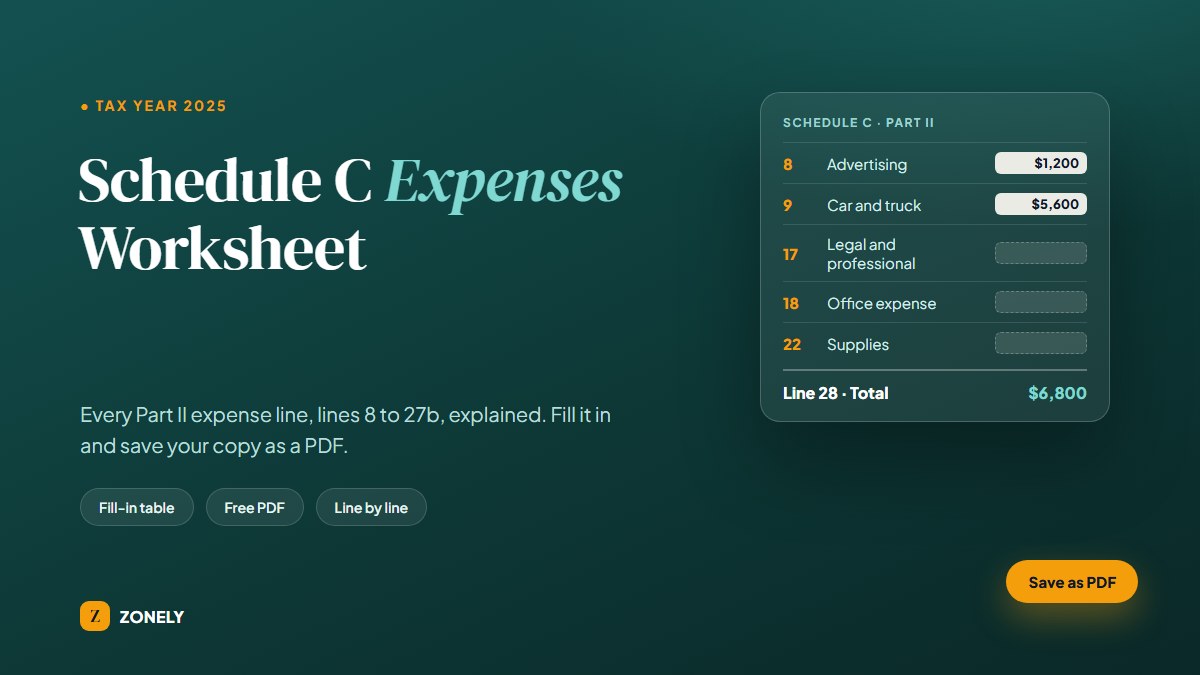
Line numbers and names below come from the 2025 Schedule C (Form 1040). Type your totals into the last column and the total expenses add up for you. Then save your filled-in copy as a PDF. The numbers stay in your browser and are not sent to us.
Schedule C Expenses Worksheet
Tax year 2025. A planning aid, not an IRS form. zonelyleads.com/blog/schedule-c-expenses-worksheet
| Line | Expense | What goes here | Your total |
|---|---|---|---|
| 8 | Advertising | Online ads, business cards, signs, website promotion, sponsorships. | |
| 9 | Car and truck expenses | Business use of a vehicle, by standard mileage or actual costs. See section 3. Commuting does not count. | |
| 10 | Commissions and fees | Marketplace and platform fees, payment-processing fees, commissions you paid. | |
| 11 | Contract labor | Payments to independent contractors (not employees). You may need to file Form 1099-NEC for larger payments. | |
| 12 | Depletion | Mining, timber, oil and gas. Rarely applies to a typical small business. | |
| 13 | Depreciation and section 179 expense deduction | Equipment, computers, furniture and vehicles written off over time or in the year bought. Usually calculated on Form 4562. | |
| 14 | Employee benefit programs (other than on line 19) | Benefits you provide to your employees, not to yourself. | |
| 15 | Insurance (other than health) | Business liability, property, professional and commercial auto policies. | |
| 16a | Interest: mortgage | Mortgage interest on business property, paid to banks. | |
| 16b | Interest: other | Interest on business loans and business credit cards. | |
| 17 | Legal and professional services | Attorney, accountant, bookkeeper and tax-preparation fees for the business. | |
| 18 | Office expense | Small office items, postage, printer ink, software subscriptions. | |
| 19 | Pension and profit-sharing plans | Contributions for your employees. Your own retirement contributions are generally claimed elsewhere, on Schedule 1. | |
| 20a | Rent or lease: vehicles, machinery, equipment | A leased car (business share) or rented equipment. | |
| 20b | Rent or lease: other business property | Office, studio, coworking space or storage. | |
| 21 | Repairs and maintenance | Keeping business equipment and property in working order. Improvements are treated differently. | |
| 22 | Supplies (not included in Part III) | Materials used up in the business that are not part of cost of goods sold. | |
| 23 | Taxes and licenses | Business licenses, permits, state and local business taxes, and the employer share of payroll taxes. Not federal income tax or your own self-employment tax. | |
| 24a | Travel | Airfare, lodging, rental cars and local transport on business trips. See section 5. | |
| 24b | Deductible meals | Enter only the deductible amount, which is generally 50% of business meal costs. | |
| 25 | Utilities | Phone, internet and electricity for a separate business space. | |
| 26 | Wages (less employment credits) | Pay to your employees, not to yourself. | |
| 27a | Energy efficient commercial bldgs deduction (attach Form 7205) | Only if you qualify and file Form 7205. Uncommon. | |
| 27b | Other expenses (from line 48) | Legitimate business costs that fit nowhere above, listed one by one in Part V: bank fees, dues, training and similar. | |
| 28 | Total expenses before home office | Add lines 8 through 27b. | $0.00 |
| 30 | Business use of your home | Figured separately. See section 4. |
Check before you rely on this. Form lines and rules change from year to year. This table follows the 2025 form. Confirm against the current IRS instructions, or ask a tax professional, before you file.
Prefer paper? Download the blank worksheet (2 pages) and fill it in by hand.
Download the blank worksheet (PDF)3. Schedule C car and truck expenses worksheet (line 9)
Line 9 is where most self-employed people claim the biggest single expense, and where records matter most. You can generally choose one of two methods for a vehicle you use in the business:
- Standard mileage: multiply your business miles by the IRS rate for that year.
- Actual expenses: track fuel, repairs, insurance, registration and depreciation, then deduct the business-use share.
| Period | IRS business mileage rate |
|---|---|
| 2025 (for your 2025 Schedule C) | 70 cents per mile |
| January 1 – June 30, 2026 | 72.5 cents per mile |
| July 1 – December 31, 2026 | 76 cents per mile |
Use this small worksheet for the standard mileage method:
| Step | Item | How to figure it | Your number |
|---|---|---|---|
| A | Business miles driven | From your mileage log, for the year. | |
| B | IRS rate | 70 cents (0.70) for 2025. | 0.70 |
| C | Line 9 deduction | Multiply A by B. | $0.00 |
Example: 8,000 business miles in 2025 at 70 cents is $5,600 on line 9. Either way, keep a log with the date, miles and business purpose of each trip. Driving between home and a regular workplace is commuting and does not count.
Drive for a rideshare or taxi platform in New York? The TLC Insurance NYC Calculator app includes a shift income and expense tracker for exactly this kind of record keeping.
4. Home office (line 30)
Expenses for the business use of your home go on line 30 only, not on the lines above. There are two ways to figure the deduction:
- Simplified method: $5 per square foot of the space used for business, up to 300 square feet, so the most you can claim is $1,500. You enter the square footage on the form and use the Simplified Method Worksheet in the IRS instructions.
- Regular method: claim the business share of rent or mortgage interest, utilities, insurance and similar costs using Form 8829.
In general the space has to be used regularly and exclusively for the business. A desk in the corner of a living room that is also used for family life usually does not qualify.
5. Travel and meals (lines 24a and 24b)
Travel (line 24a) covers costs of overnight business trips: transport, lodging and similar expenses. Meals go on their own line (24b), and you enter only the deductible part.
- Business meals: generally 50% deductible when they are an ordinary and necessary business expense.
- Client entertainment: such as tickets or outings, is generally not deductible.
- Records: note who you met, the business purpose, the date and the amount.
6. Common mistakes that cost money
- Mixing personal and business spending. Only the business share of a mixed-use expense counts.
- Putting your own health insurance on line 15. That line is for insurance other than health. Self-employed health insurance is generally handled on Schedule 1.
- Claiming 100% of meals. Line 24b takes only the deductible amount.
- Deducting the same cost twice. Home office costs go on line 30 only, not again on lines 18, 21 or 25.
- Burying everything in "other expenses." Use the specific line when one exists, and list line 27b items individually in Part V.
- No mileage log. A round-number guess is the easiest car deduction to lose.
7. Records to keep
- Receipts and invoices that show the amount, date and what was bought.
- Bank and credit card statements that match each expense.
- A mileage log with date, miles and purpose for every business trip.
- Forms 1099 you received and, for contractors you paid, a signed Form W-9.
- Home office details, such as the square footage of the space and a floor plan or photo.