how much filling cost without insurance
How Much Does a Filling Cost Without Insurance? Your 2026 Price Guide
Discovering a cavity is never fun, but the stress often doubles when you start wondering: "How much does a filling cost without insurance?" In the USA, dental costs can feel like a moving target, especially when you are paying out of pocket.
The good news? A dental filling is one of the most affordable restorative procedures available. Catching a cavity early can save you from a $1,000+ root canal later. Here is the complete breakdown of what you can expect to pay for a dental filling in 2026.
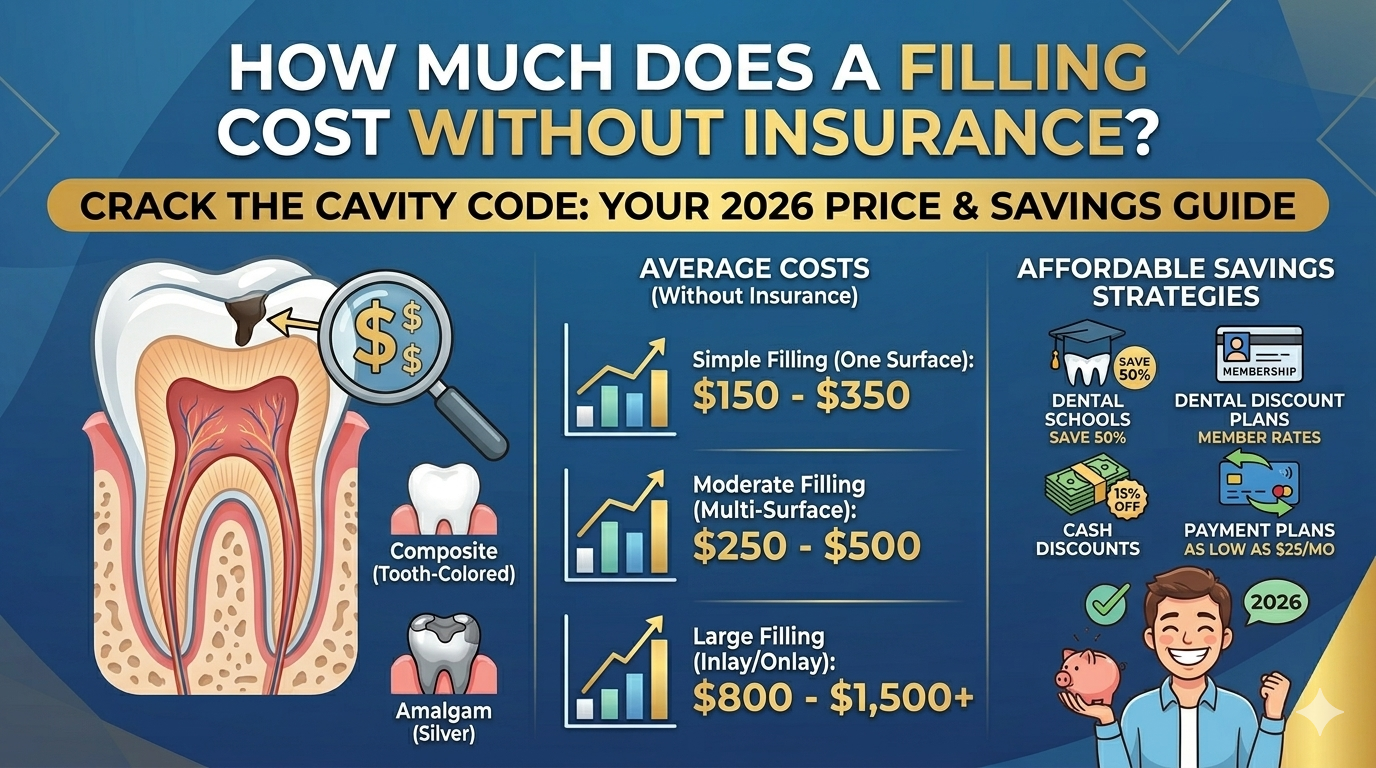
Average Filling Cost Without Insurance (By Material)
The most significant factor in your bill is the material used. Dentists typically offer four main types:
| Filling Type | Aesthetic | Durability | Average Cost (Per Tooth) |
| Amalgam (Silver) | Silver/Dark | 10–15 Years | $150 – $350 |
| Composite (White) | Tooth-Colored | 5–10 Years | $200 – $500 |
| Porcelain (Inlays) | Very Natural | 15+ Years | $800 – $1,500 |
| Gold | Gold | 20+ Years | $1,000 – $4,500 |
1. Amalgam (Silver) Fillings
These are the most "budget-friendly" options. Made from a mix of metals, they are extremely durable and ideal for back molars where they aren't visible.
2. Composite (Tooth-Colored) Fillings
The most popular choice for front teeth. They blend seamlessly with your natural smile. While slightly more expensive than silver, they require less "drilling" or removal of healthy tooth structure.
3. Porcelain & Gold (Inlays/Onlays)
These are technically "indirect" fillings made in a lab. They are much more expensive but are the gold standard for durability and strength in large cavities.
Factors That Affect Your Total Bill
Beyond the material, your final "walk-out" price depends on:
-
Number of Surfaces: A small "one-surface" filling on the top of a tooth is cheaper than a "three-surface" filling that wraps around the side.
-
The Exam & X-Rays: Most dentists require a $50–$200 exam and $25–$150 X-rays to diagnose the cavity before they can fill it.
-
Geographic Location: Expect to pay 20% more in major cities like New York or San Francisco compared to rural areas.
-
The Tooth's Location: Molars are harder to reach and often take more time/material, slightly increasing the labor cost.
5 Ways to Save Money on Fillings (No Insurance Needed)
If the "sticker price" feels high, don't ignore the cavity—it will only grow. Instead, try these 2026 cost-saving strategies:
-
Dental Schools: Accredited dental schools offer high-quality care at 50% of the cost. Procedures are performed by students and supervised by licensed professors.
-
Dental Discount Plans: These are memberships (like a Costco for teeth) where you pay a small annual fee to access "pre-negotiated" rates at local dentists.
-
The "Cash Discount": Many offices will shave 10–15% off your bill if you pay in full with cash on the day of service.
-
Health Centers (FQHCs): Federally Qualified Health Centers offer "sliding scale" fees based on your income.
-
Financing (CareCredit): Most modern offices offer monthly payment plans through third-party lenders, allowing you to pay as little as $25/month.
The Real Cost of Waiting
A small $200 filling today is a minor inconvenience. If left untreated, that cavity will reach the nerve, requiring a root canal ($800–$1,500) and a crown ($1,000–$2,000).
Summary: Most uninsured patients in the USA will pay between $200 and $450 for a standard tooth-colored filling.